d) Movement of substances into and out of cells:
2.12 understand definitions of diffusion, osmosis and active transport
Diffusion: the net movement of particles from an area of higher concentration to an area of lower concentration
Osmosis: the net movement of water molecules across a partially permeable membrane, from a region of high water concentration (low solute concentration) to a region of lower water concentration (high solute concentration)
Active transport: movement of substances against a concentration gradient, using energy from respiration.
2.13 understand that movement of substances into and out of cells can be by diffusion, osmosis and active transport.
2.14 understand the importance in plants of turgid cells as a means of support - TRIPLE SCIENCE ONLY:
When plants are well watered, the cells take in water by osmosis and the cells become turgid (the contents of the cell push against the cell wall). This helps to support the plant. When there's not enough water, the cells lose water by osmosis and become flaccid, and the plant wilts.
2.15 understand the factors that affect the rate of movement of substances into and out of cells, to include the effects of surface area to volume ratio, temperature and concentration gradient.
2.12 understand definitions of diffusion, osmosis and active transport
Diffusion: the net movement of particles from an area of higher concentration to an area of lower concentration
Osmosis: the net movement of water molecules across a partially permeable membrane, from a region of high water concentration (low solute concentration) to a region of lower water concentration (high solute concentration)
Active transport: movement of substances against a concentration gradient, using energy from respiration.
2.13 understand that movement of substances into and out of cells can be by diffusion, osmosis and active transport.
2.14 understand the importance in plants of turgid cells as a means of support - TRIPLE SCIENCE ONLY:
When plants are well watered, the cells take in water by osmosis and the cells become turgid (the contents of the cell push against the cell wall). This helps to support the plant. When there's not enough water, the cells lose water by osmosis and become flaccid, and the plant wilts.
2.15 understand the factors that affect the rate of movement of substances into and out of cells, to include the effects of surface area to volume ratio, temperature and concentration gradient.
- Surface area to volume ratio:
- the rate is higher when there is a larger surface area to volume ratio
- Temperature:
- particles are warmer and have more energy, which means they move faster
- Concentration gradient:
- the rate is faster if there is a big difference in concentration
- ONLY affects osmosis and diffusion, NOT active transport
2.16 describe experiments to investigate diffusion and osmosis using living and non-living systems
Osmosis: living system:
- Measure and put some potato cylinders in a beaker with pure water, and others in a beaker with a concentrated sugar solution and leave for eg 30 mins
- Measure the cylinders after 30 mins.
- If they were in water, they should be longer, if they were in the sugar solution, they should be shorter.
- Repeat with different concentrations of sugar solutions
- Keep the volume and the time the same for a fair test
Osmosis: non-living system:
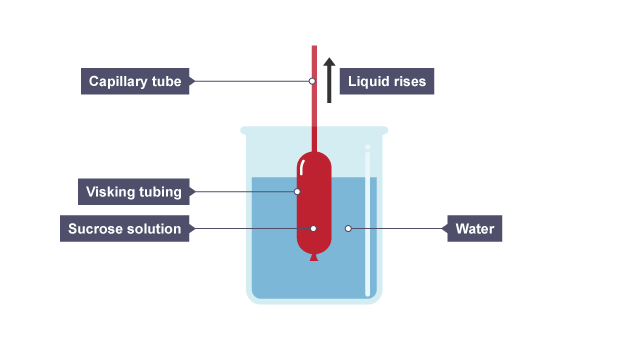
- Set up some visking tubing (containing a sugar solution) with a glass tube at the top, in a beaker filled with water
- Measure where the liquid comes up to on the glass tube and leave overnight
- Measure where the liquid is. Water should have been drawn into the tubing by osmosis, forcing the liquid up the glass tube.
Diffusion: non-living system:
- Make some agar jelly with phenolpthalein indicator and dilute sodium hydroxide
- Place some cubes of the jelly into a beaker of dilute hydrochloric acid
- If you leave them they turn colourless as the acid diffuses into the agar jelly and neutralises the sodium hydroxide
Comments
Post a Comment